



Understanding System Marginal Price (SMP) Under Solar ATAP
2025-12-24


And Why Energy Storage Matters More Than Ever

Solar ATAP places greater emphasis on timing, controllability, and system-aware operation.
The Solar Accelerated Transformation Programme (Solar ATAP) has been widely anticipated as Malaysia’s next rooftop solar framework following the conclusion of Net Energy Metering (NEM).
While Solar ATAP was initially expected to roll out in December 2025, the Ministry of Energy Transition and Water Transformation (PETRA) clarified on 19 December 2025 that:
- The Solar ATAP guidelines will be published on 31 December 2025 by the Energy Commission (Suruhanjaya Tenaga), and
- The programme will commence from 1 January 2026, with applications submitted via SEDA Malaysia.
PETRA further confirmed that Solar ATAP introduces different settlement mechanisms for domestic and non-domestic users, marking a structural shift from the NEM framework.
1.How Exported Solar Energy Is Valued Under Solar ATAP ?
According to PETRA’s official announcement:
- Domestic users will receive energy offsets based on the Energy Charge component of the retail tariff;
- Non-domestic users (commercial and industrial) will have exported solar energy settled based on System Marginal Price (SMP), which reflects system marginal costs determined through power system operations.
Solar ATAP does not impose a fixed national quota, although the government retains the right to intervene or impose limits should exported solar energy adversely affect grid stability.
2. What Is System Marginal Price (SMP)?
System Marginal Price (SMP) refers to the electricity price determined for each settlement period—typically every 30 minutes—based on the operating cost of the last generating unit dispatched to meet system demand.
As outlined in the “Guide To Determine The System Marginal Price” issued by the Grid System Operator (GSO), SMP represents the marginal cost required to balance the power system at a specific moment, rather than an average cost across all generators.
In practical terms, SMP answers a system-level question:
What does the power system need to pay to supply the next unit of electricity at that time?
3. What Does “Marginal” Mean in This Context?
In power system operations, “marginal” refers to the generator dispatched last to meet demand during a settlement period.
This generator operates at the boundary between supply and demand. Its operating cost becomes the reference price—SMP—for that interval.
SMP therefore reflects time-specific system conditions, not a blended or retail electricity price.
4. Why Solar ATAP Uses SMP Instead of Retail Offsets ?
Under NEM, exported solar energy was offset on a one-to-one basis against retail tariffs, which included energy, capacity, and network components.
Solar ATAP adopts a different approach. For non-domestic users, exported energy is valued using SMP, a market-based price signal grounded in power system operations rather than retail billing structures.
This change aligns solar exports with system marginal costs, rather than treating rooftop solar as a full substitute for retail electricity consumption.
5. Why Solar Returns May Appear Lower Under SMP ?
In systems with growing solar penetration, electricity generation typically peaks during midday hours, when overall system demand is lower and marginal generation costs are relatively low.
Under an SMP-based framework, electricity value depends not only on how much energy is produced, but when it is delivered.
As a result, exported solar energy during low-demand periods naturally receives a lower settlement price compared to peak-demand hours.
This explains why Solar ATAP outcomes may appear less financially attractive when compared directly to NEM, without implying that rooftop solar has lost system relevance.
6. Where Battery Energy Storage Fits In
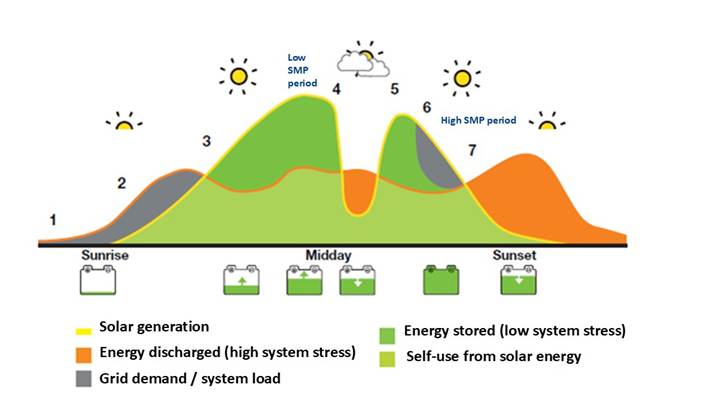
Under SMP, electricity value is shaped by timing and system conditions — not just generation volume. Energy storage enables solar energy to support the grid when it matters most.
Illustration adapted and simplified for explanatory purposes.
A Battery Energy Storage System (BESS) does not alter pricing rules under Solar ATAP. Instead, it changes the timing of energy delivery.
By storing solar energy during periods of lower SMP and releasing it during periods of higher system demand—when marginal generation costs are higher—storage enables electricity to participate in the system when its value is greater.
This process, commonly referred to as time-shifting, operates fully within the SMP framework and does not interfere with price formation.
7. Does Solar ATAP Signal a Shift Toward Dispatch-Aware Resources?
Yes—implicitly.
By linking non-domestic solar exports to SMP and reinforcing system-based settlement principles, Solar ATAP places greater emphasis on operational compatibility, timing, and controllability.
In this environment, energy resources that can respond predictably to system conditions—and integrate with dispatch, grid constraints, and technical requirements—are increasingly aligned with how value is assessed.
8. What This Transition Signals for the Market ?
Solar ATAP reflects a broader transition in Malaysia’s power sector:
- From valuing electricity primarily by volume,
- To valuing it by system relevance and timing.
Generation alone no longer guarantees value.
Resources that can deliver electricity when the system needs it most, and in a manner compatible with grid operations, will play a growing role as Malaysia’s energy transition progresses.
SynVista’s Perspective: From Energy Output to System Capability

From a system perspective, Solar ATAP does not remove the role of rooftop solar. Instead, it reframes how value is recognised within the power system.
Energy storage, when deployed as a dispatch-compatible, system-aware resource, supports grid stability, reduces reliance on higher-cost marginal generation, and enables more orderly integration of renewable energy within existing rules.
Looking ahead, the evolution of energy storage will be shaped less by capacity metrics alone, and more by system compatibility, operational discipline, and long-term reliability—principles that align closely with the regulatory direction articulated under Solar ATAP.
About SynVista Energy
SynVista Energy is a Singapore-headquartered renewable energy solutions provider committed to delivering reliable and secure green energy services. The company offers high-quality energy storage system manufacturing and turnkey engineering services, as well as customized energy storage asset development and operation solutions. Its business spans Southeast Asia, the United States, Europe, and China.
To learn more about Synvista’s ESS safety technologies, partnership opportunities, or system platforms, please contact us at:
📧 marketing@synvista.com
🌐 www.synvista.com
Follow SynVista Energy on LinkedIn and Facebook for the latest updates on our energy storage innovations, project highlights, and industry insights.
Contact Information
Prefer to solve all your questions together soon? We protect your privacy and respond within 24 hours.